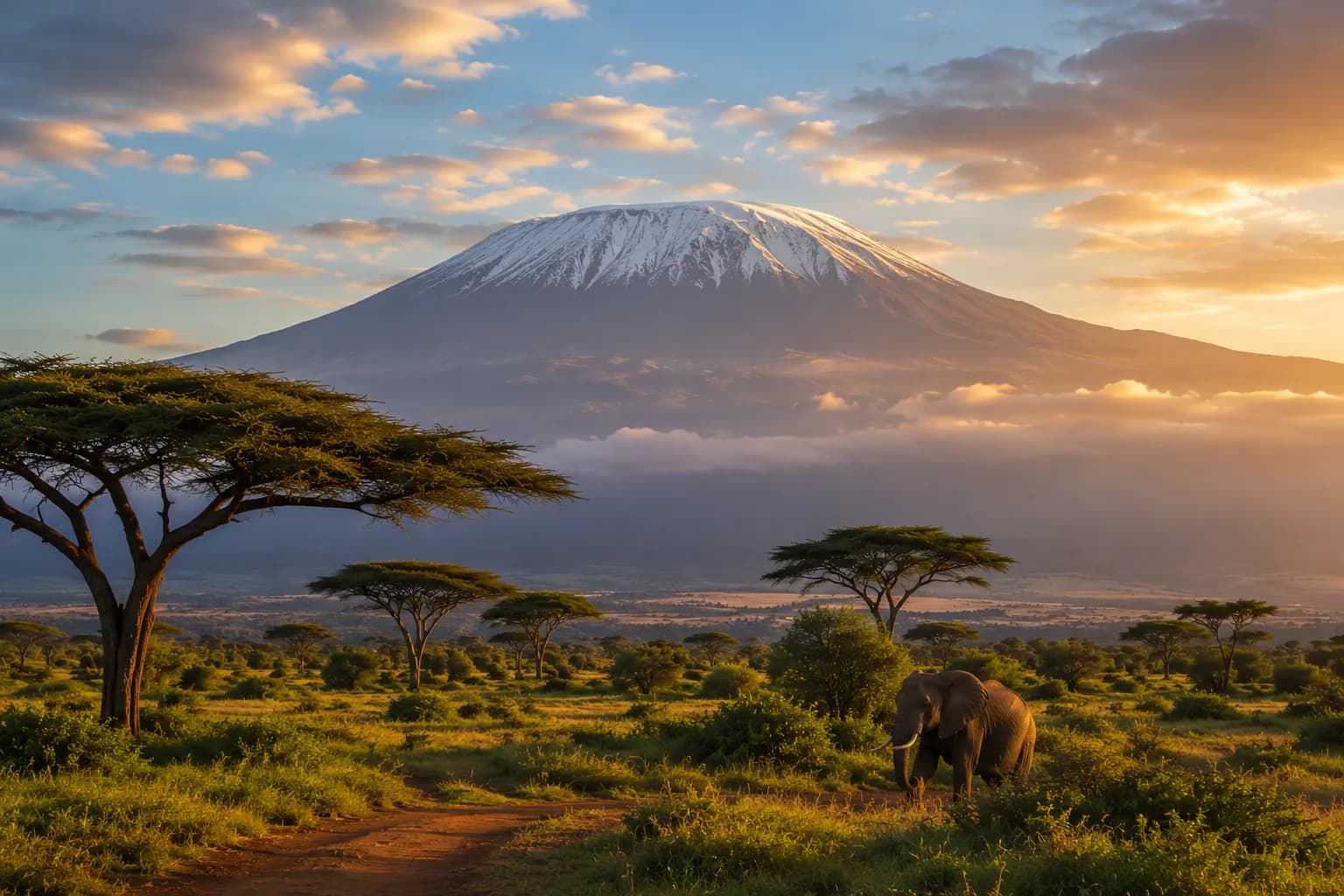
Kilimanjaro Lemosho Route — 8 Days on the Mountain
The quieter, more gradual way up Kilimanjaro: eight days on the Lemosho route, from the remote western side of the mountain, through rainforest where few other climbers walk, across the whole width of the Shira Plateau and around the south side of Kibo to the high camp at Barafu, then summit night to Uhuru Peak, 5,895 m. With an extra day on the plateau and the 'climb high, sleep low' day at the Lava Tower, it gives some of the best acclimatisation of any route.
The trip is ten days in all, with nights in Moshi before and after the climb. You camp each night in tents put up by your crew of licensed guides, assistant guides, porters and a cook. Below the Lava Tower the route joins the Machame route, so the busier stretches come later, but the first days on the western slopes are among the quietest on the mountain. No technical skill is needed, but you should be fit enough to walk five to eight hours a day; the minimum age for a summit climb is 10.
Highlights
- 01Uhuru Peak, 5,895 m, the summit of Africa
- 02Eight days on the mountain — some of the best acclimatisation of any route
- 03Quiet rainforest on the remote western slopes
- 04The whole width of the Shira Plateau, with two nights on it
- 05The Lava Tower, the Barranco Wall and the sunrise on the crater rim
- 06Nights in Moshi before and after the climb
Day-by-Day Itinerary
- 01Day 1
Arrival in Moshi
Land at Kilimanjaro International Airport and transfer to your hotel in Moshi, at the foot of the mountain, about an hour away. In the evening your guide holds the briefing and checks your kit.
- 02Day 2
Londorossi Gate → Mti Mkubwa Camp (about 2,750 m)
A long drive round the western side of the mountain to the Londorossi Gate for registration, then on to the Lemosho trailhead and three to four hours through the rainforest, where black-and-white colobus call in the canopy, to Mti Mkubwa, the 'big tree' camp.
- 03Day 3
Mti Mkubwa → Shira 1 Camp (about 3,500 m)
Out of the forest and up through the heather and giant heath onto the western edge of the Shira Plateau, five to six hours, with the first views of Kibo.
- 04Day 4
Shira 1 → Shira 2 Camp (about 3,850 m)
An easy day across the plateau, the collapsed caldera of an ancient volcano, four to five hours, with time to acclimatise and a short walk higher in the afternoon.
- 05Day 5
Shira → Lava Tower (about 4,600 m) → Barranco Camp (about 3,950 m)
The key acclimatisation day: six to eight hours across the alpine desert to the Lava Tower, a tower of volcanic rock at about 4,600 m, for lunch, then down into the Barranco Valley, among giant groundsels, to sleep about 650 m lower.
- 06Day 6
Barranco Wall → Karanga Camp (about 4,000 m)
Morning on the Barranco Wall, a scramble of an hour or two using your hands as well as your feet, then up and down across the valleys below the southern glaciers to Karanga Camp, four to five hours in all.
- 07Day 7
Karanga → Barafu Camp (about 4,670 m)
A short climb of three to four hours over bare rock to Barafu, the high camp, for an early dinner and a few hours' rest before summit night.
- 08Day 8
Summit night — Uhuru Peak (5,895 m) → Mweka Camp (about 3,100 m)
Leave camp around midnight and climb for six to eight hours by headtorch, up the scree to Stella Point on the crater rim and along it to Uhuru Peak, 5,895 m, for the sunrise over the glaciers. Then down to Barafu for a rest and on to Mweka Camp in the forest — twelve to fifteen hours on your feet, the hardest and best day of the climb.
- 09Day 9
Mweka Camp → Mweka Gate → Moshi
Three to four hours down through the rainforest to the Mweka Gate, about 1,640 m, where you collect your summit certificate, say goodbye to the crew and drive back to your hotel in Moshi for a shower and a celebration.
- 10Day 10
Departure
Transfer to Kilimanjaro International Airport for your flight home, or on to Arusha for a safari in Tarangire, Ngorongoro and the Serengeti, or a flight to Zanzibar for the beach.
What’s Included
- ✓Kilimanjaro National Park fees: conservation, camping and rescue fees
- ✓A licensed mountain guide, assistant guides, porters and a cook
- ✓All meals on the mountain and drinking water
- ✓Tents, sleeping mats and mess-tent equipment
- ✓Two nights in Moshi, before and after the climb, with breakfast
- ✓Transfers from Kilimanjaro International Airport, to the gate and back
Not Included
- –International flights to Kilimanjaro (JRO)
- –Tanzania visa, and travel insurance covering trekking to 6,000 m
- –Tips for the mountain crew
- –Personal kit: sleeping bag, boots and clothing (some can be hired in Moshi)
- –Drinks, and meals in Moshi other than breakfast
Tanzania — Serengeti, Ngorongoro & Zanzibar
Tanzania is home to the legendary Serengeti, the Ngorongoro Crater, Mount Kilimanjaro, and the pristine beaches of Zanzibar. The Serengeti's endless plains host the Great Wildebeest Migration, one of the largest land migrations on Earth; the Ngorongoro Crater is a UNESCO World Heritage Site sheltering the densest Big Five population on the continent.
Explore Tanzania in full →Frequently Asked Questions
Why choose the Lemosho route?
+
For its acclimatisation and its quiet start: eight days give your body time to adjust, and the first days on the western slopes see far fewer climbers than Machame or Marangu. It is one of the most scenic routes on the mountain.
How long is the Lemosho route?
+
About 70 km over eight days on the mountain, from the Londorossi Gate in the west to the Mweka Gate in the south; the trip is ten days with the nights in Moshi.
Lemosho or Machame?
+
Both share the same route from the Lava Tower to the summit. Lemosho starts further west, adds a day on the Shira Plateau and is quieter for the first three days; Machame is a day shorter and starts closer to Moshi.
How much does the Lemosho route cost?
+
Park fees alone are around USD 800 to 1,500 per climber in 2026, depending on the route and the number of days; a full climb with guides, porters, food, equipment and transfers costs several times that. We quote each climb for your dates and group size.
When is the best time to climb the Lemosho route?
+
January to early March and June to October, the driest months. The long rains of April and May and the short rains of November make the trails muddy and the views less reliable.