Egypt Travel Guide 2025: Pyramids, Nile Cruises, Luxor & the Red Sea
Egypt is the greatest open-air museum on Earth — and one of the most technically complex destinations to plan well. The Pyramids of Giza are extraordinary, but the Pyramids visited wrong (wrong time of day, without a guide, in a tour group) are an exercise in queue management. This guide tells you how to do Egypt correctly — from the Pyramids to the Nile to the Valley of the Kings to the Red Sea.
Quick Answer: Visit Egypt in October–April for comfortable temperatures. For a first visit, spend 3 nights Cairo + 4 nights Nile cruise (Luxor–Aswan) + 2 nights Abu Simbel. Choose a dahabiya over a cruise ship for an authentic Nile experience. Always hire a licensed Egyptologist guide for the Pyramids and temples.
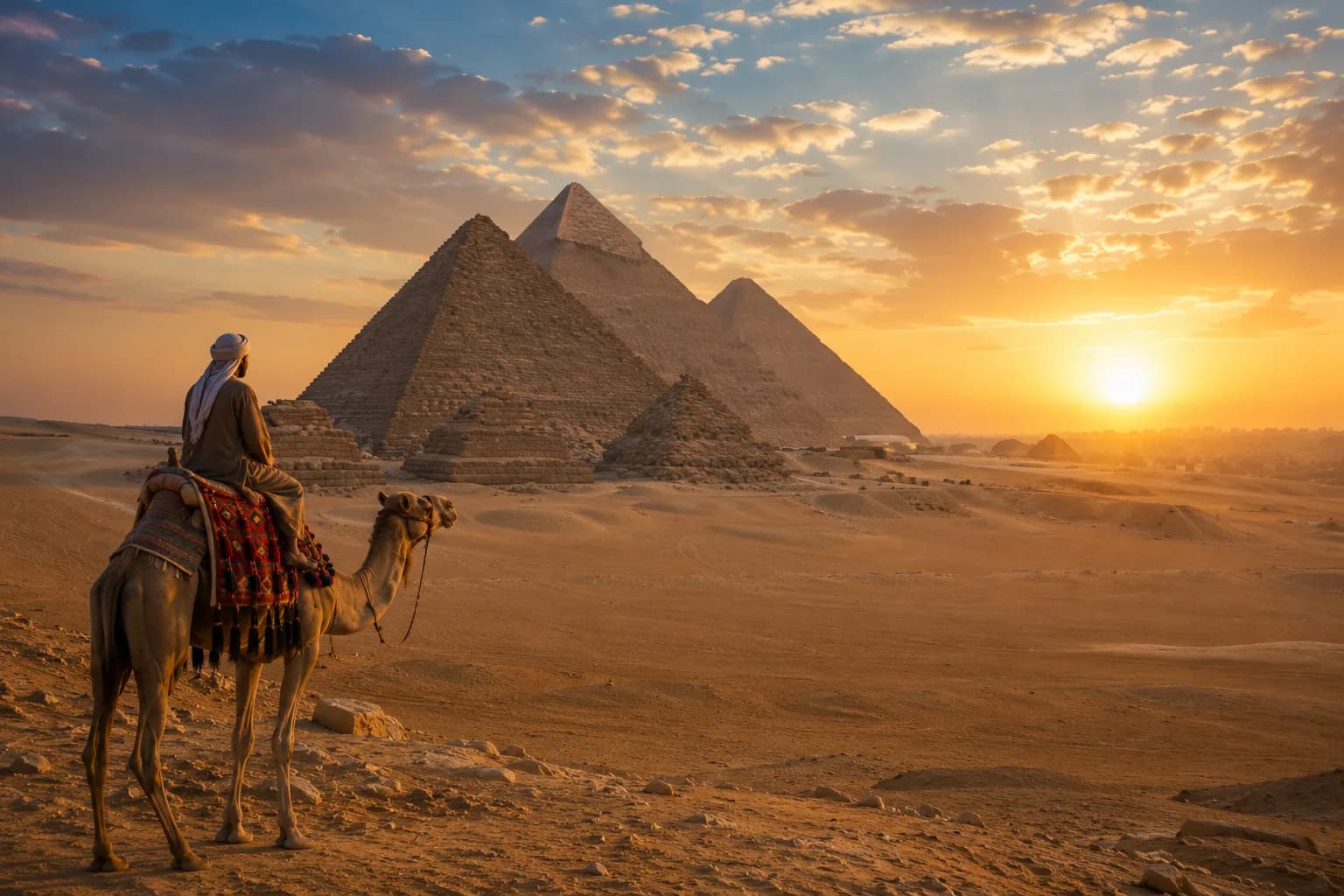
Standing at the base of the Great Pyramid of Giza — 2.6 million limestone blocks, the largest weighing 15 tonnes, assembled with precision that modern laser alignment equipment struggles to replicate — is an experience that fundamentally recalibrates your sense of human time. The Pyramid was 2,500 years old when Cleopatra was born. At 4,500 years old, the Great Pyramid is still the most impressive engineering achievement in human history, and it still has the capacity to astonish someone who has read everything about it and thinks they are prepared.
Egypt is also a complicated destination to visit well. The infrastructure for tourism is well-developed but the quality of experience varies enormously depending on timing, guide quality, and itinerary structure. This guide ensures you see the monuments at their most atmospheric, with the right context, at the right time of day.
Egypt Safety: What You Need to Know
- SAFETY OVERVIEW: Egypt's main tourist sites – Cairo, Luxor, Aswan, Hurghada, Sharm el‑Sheikh – are safe for international visitors.
- TOURIST POLICE: The Egyptian Tourist Police have a significant presence at all major sites. They are there for your safety.
- SCAMS: "Temple closed" redirects (students pretending the site is closed, redirecting you to their "family's shop") are common. Ask a police officer or official ticket booth – not the guide at the entrance.
- DRIVING: Cairo traffic is challenging. Use private drivers arranged through your hotel or operator. Do not drive yourself in Cairo.
- HEALTH: Drink bottled water only (single‑use plastic water bottles are common and cheap). Avoid street food from stalls without high turnover – stick to established restaurants.
- DRESS CODE: Cover shoulders and knees at religious sites (mosques, some temples). Conservative clothing is respectful and reduces unwanted attention in markets.
What to Wear in Egypt: Comfort and Respect
- LIGHTWEIGHT, LOOSE CLOTHING: Linen and cotton are ideal for 35°C+ days. Loose covers protect from the sun.
- SCARF FOR WOMEN: Essential for mosque visits (all major mosques). Many provide coverings, but your own is better.
- WALKING SHOES: Comfortable trainers or hiking sandals – Egyptian sites have uneven ground, sand, and steps.
- SUN PROTECTION: Wide‑brimmed hat, SPF 50+ sunscreen, sunglasses, and a light long‑sleeved cover for the sun.
- EVENING LAYER: Evenings in winter (December–February) can be cold (10–15°C). A light jacket or fleece is recommended.
- RESPECTFUL DRESS: In markets and old Cairo, cover shoulders and knees. In beach resorts (Hurghada, Sharm), Western swimwear is fine.
Egypt Itinerary: How Many Days for What Experience
| Duration | What You Cover | Best For | Assessment |
|---|---|---|---|
| 5 days | Cairo (Pyramids, Egyptian Museum, Khan el-Khalili) + Luxor (Karnak, Valley of the Kings, Luxor Temple) | First-time visitors combining Egypt with another destination | The essential circuit — see the two greatest ancient sites. Rushed but achievable. |
| 7–8 days | Above + Nile cruise (Luxor → Aswan, 3 nights) including Edfu, Kom Ombo, Philae | Most common first-time Egypt holiday length | Our recommended minimum for a meaningful Nile experience. |
| 10–12 days | Full circuit: Cairo + Nile cruise + Abu Simbel (fly or early morning drive) + Red Sea (3 nights) | First-time visitors wanting the complete Egypt experience | The comprehensive Egypt trip. Abu Simbel is unmissable; Red Sea adds diving and recovery. |
| 14 days | All of the above + Western Desert (White Desert + Farafra + Siwa Oasis) | Repeat visitors; adventurous first-timers; Egypt enthusiasts | The definitive Egypt journey. The White Desert is one of the most extraordinary landscapes on Earth. |
The Pyramids of Giza: What Nobody Tells You in Advance
The Pyramids of Giza sit at the western edge of Greater Cairo, on a limestone plateau that abuts the desert to the west and the suburbs of Giza to the east. This proximity to the city is the first thing that surprises most visitors — the Pyramids are not in a remote desert. You will have the Pyramids on one side and apartment blocks on the other. This is not a disappointment once you understand it; it is actually extraordinary — an ancient wonder embedded in a living city.
- ARRIVE AT OPENING TIME (07:00): The Giza Plateau opens at 07:00 and the first tour buses arrive at approximately 08:30–09:00. The 90 minutes between opening and the first large groups is the closest thing to a private Giza experience available. The light is extraordinary at 07:00 — long, golden, raking across the limestone surfaces.
- BOOK A LICENSED EGYPTOLOGIST GUIDE: The difference between visiting the Giza Plateau without a guide and with a licensed Egyptologist who specialises in the Old Kingdom is the difference between seeing three large piles of stones and understanding 4,500 years of political, religious, astronomical, and engineering history.
- THE GREAT SPHINX IS SMALLER THAN YOU EXPECT. THE PYRAMIDS ARE LARGER: The most consistent observation from first-time visitors. The Sphinx (20 metres tall, 73 metres long) is impressive but not overwhelming. The Great Pyramid (138.8 metres; originally 146.7 metres) is genuinely, physically overwhelming. The scale is impossible to communicate in photographs.
- ENTER THE PYRAMID: Tickets to enter the Great Pyramid or Khafre are sold separately and strictly limited per day. The experience is not for the claustrophobic — the descending passage to the King's Chamber is 1 metre by 1.2 metres at a 26° angle. But standing in the granite King's Chamber, inside the Great Pyramid, in near silence, is one of the most extraordinary moments available to any traveller anywhere.
- SOLAR BOAT MUSEUM: A 4,600-year-old cedar boat found buried beside the Great Pyramid, preserved almost perfectly. If you visit one thing beyond the Pyramids themselves, it is this — an object that connects you to ancient Egypt as physical reality, not abstraction.
Nile Cruise: Dahabiya vs Cruise Ship — The Complete Comparison
| Factor | Standard Cruise Ship (100–250 passengers) | Luxury Small Ship (20–50 passengers) | Dahabiya (Traditional Sail Boat, 8–20 passengers) |
|---|---|---|---|
| Passengers | 100–250 tourists | 20–50 guests | 8–20 guests (often private charter) |
| Temple access timing | Fixed schedule; arrive same time as 12 other ships | Better scheduling; smaller groups | Completely flexible — moor when you want; visit at dawn or dusk when sites are empty |
| Onboard experience | Buffet dining; pool; basic cabin | Better cabins; à la carte dining | Extraordinary — your own vessel; private meals on deck; complete silence at anchor |
| Atmosphere | Package holiday; resort energy | Better but still group-oriented | Genuinely romantic; 19th-century-explorer energy; the Nile as it was meant to be experienced |
| Cost | USD 100–200pp/night all-inclusive | USD 250–500pp/night | USD 400–1,500pp/night (private charter vs joining a public trip) |
| Duration | 3–4 nights Luxor → Aswan | 3–4 nights | 5–8 nights for the leisurely pace the dahabiya requires |
| Our Recommendation | Not recommended for discerning travellers — the bus-and-buffet experience reduces the Nile to a backdrop | A significant improvement worth the premium | The definitive Nile experience. If considering the Nile at all, dahabiya should be your reference point. |
Luxor: The World's Greatest Open-Air Museum
Luxor (ancient Thebes) is the most important repository of ancient Egyptian monuments in the world — more than 33% of all the world's ancient monuments are concentrated in the Luxor governorate. The east bank was the city of the living (Karnak Temple, Luxor Temple); the west bank was the city of the dead (Valley of the Kings, Valley of the Queens, Hatshepsut's Temple). Two days in Luxor is the absolute minimum; three days is our recommendation.
- KARNAK TEMPLE COMPLEX: The largest religious building ever constructed on Earth — 25 centuries of continuous construction beginning in 1550 BC. The Hypostyle Hall alone (134 papyrus columns, the largest weighing 70 tonnes, the tallest rising 24 metres) is so overwhelming that many visitors stand in it in complete silence for several minutes. Visit at opening (06:00) and stay until the tour groups arrive at 08:30.
- VALLEY OF THE KINGS: The burial site of Egypt's New Kingdom pharaohs (1550–1070 BC) — 63 known tombs carved into limestone cliffs. Standard entry includes 3 tombs; separate tickets required for Tutankhamun's tomb, Nefertari's tomb (Valley of the Queens; the most beautiful painted walls in Egypt), and Seti I's tomb (the finest painted tomb; currently restricted). Hire an Egyptologist guide for context.
- HATSHEPSUT MORTUARY TEMPLE (DEIR EL-BAHARI): The three-terraced temple dedicated to the female pharaoh Hatshepsut (1507–1458 BC) — one of the most architecturally elegant structures in ancient Egypt. Extraordinary at dawn when light hits the colonnades. Arrive at opening (06:00) to avoid the crowds.
- LUXOR TEMPLE: The one ancient monument most dramatic at night — floodlit from sunset, situated in the heart of the modern city, with the sound of the muezzin from the mosque built inside the ancient precinct echoing over the hypostyle columns. Walk here from your hotel after dinner.
- HOT-AIR BALLOON OVER THE WEST BANK (DAWN): A balloon lifts off at first light from the west bank and drifts over the Valley of the Kings, Hatshepsut's Temple, and the flood plain — the view from altitude over 3,500 years of history in a single field of vision is genuinely moving. Weather-dependent; book in advance.
Abu Simbel: The Temple That Was Moved
Abu Simbel is the greatest UNESCO World Heritage rescue operation in history. Built by Ramesses II (1279–1213 BC) and oriented so precisely that sunlight reaches the innermost sanctuary on February 22nd and October 22nd (dates associated with the pharaoh's birthday and coronation), the two temples were threatened with submersion by the rising waters of Lake Nasser behind the Aswan High Dam in the 1960s. Between 1964 and 1968, UNESCO organised an international operation to cut both temples into 1,041 numbered blocks, move them 65 metres uphill, and reassemble them exactly — at a cost of USD 40 million.
The experience of Abu Simbel in person is extraordinary not just for the temples but for the surrounding landscape — a vast blue lake in the middle of the Sahara, the temple façade with its four 20-metre seated colossi of Ramesses II reflecting in the water. Access is by flight from Aswan (45 minutes) or a very early morning drive across the desert (3.5 hours; departure at 04:00). The flight is our recommendation — the dawn arrival from the air, banking over Lake Nasser and seeing the temples from altitude, is itself an extraordinary experience.
When to Visit Egypt: Temperature, Crowds, and the Honest Guide
| Month | Temperature (Cairo/Luxor) | Red Sea Temperature | Crowd Level | Verdict |
|---|---|---|---|---|
| October | 27–32°C | 28°C | Moderate — building from low season | Excellent: comfortably warm; sites not crowded; Red Sea excellent |
| November | 22–27°C | 26°C | Moderate-High | Very Good: pleasant temperatures; manageable crowds |
| December | 18–22°C | 24°C | High (Christmas) | Good for most of the month; Christmas week is peak — avoid if possible |
| January | 15–20°C | 22°C | Moderate | Excellent: coolest and most comfortable for temple sightseeing |
| February | 17–22°C | 22°C | Moderate | Excellent: very comfortable temperatures; good hotel rates |
| March | 22–27°C | 24°C | Moderate-High | Good: warming; comfortable; khamsin dust winds can begin in late March |
| May | 33–39°C | 27°C | Low | Hot. Temple visits challenging by 10:00. Not recommended for first-time visitors. |
| June–September | 38–45°C+ | 28–31°C | Very Low | Extreme heat. Upper Egypt genuinely dangerous at midday. Diving season on Red Sea. |
The Red Sea: Where to Dive and Stay
Egypt's Red Sea coast is one of the world's great diving destinations — clear, warm water with visibility often exceeding 30 metres, extraordinary coral reef systems, and a remarkable diversity of marine life including reef sharks, Napoleon wrasse, dugongs in some areas, and extraordinary pelagic life at the offshore drop-offs. The two main resort areas are Hurghada (well-developed, easy access from Cairo; 45-minute flight) and Marsa Alam (more remote, more pristine, better reef systems, significant dugong population). Diving at the Elphinstone Reef (Marsa Alam) — an offshore pinnacle that descends into the abyss with reliable oceanic whitetip shark sightings — is one of Egypt's genuinely world-class experiences for experienced divers.
Frequently Asked Questions
Is Egypt safe to visit in 2025?
+
Egypt's main tourist destinations — Cairo, Luxor, Aswan, Hurghada, Sharm el-Sheikh — have excellent safety records for international visitors. Egyptian Tourist Police have a significant presence at all major sites. We advise following current Foreign Office or State Department guidance for your nationality, and avoiding areas not on standard tourist circuits (North Sinai; areas near the Libyan border). The vast majority of our clients visit Egypt without any safety concerns.
What is the best way to see the Pyramids of Giza?
+
Arrive at 07:00 when the plateau opens, before the first tour groups (08:30–09:00). Hire a licensed Egyptologist guide — not a general tourist guide, specifically an Egyptologist with a university degree. Book your pyramid interior entry ticket in advance; numbers are strictly limited daily. Allow 3–4 hours for the full plateau. The Solar Boat Museum adds 45 minutes and is strongly recommended.
How do I choose between a dahabiya and a cruise ship for the Nile?
+
If budget allows, choose a dahabiya without hesitation. The experience — your own vessel, flexible temple timing (visiting at dawn and dusk when sites are empty), extraordinary meals on deck — is incomparably superior to the large cruise ship experience. A good dahabiya charter for 2 people for 5 nights runs USD 2,500–5,000 depending on the vessel.
Do I need a guide for Egypt?
+
Yes — more than for almost any other destination. Egypt's monuments are extraordinary but deeply contextual; without understanding the dynastic timeline, the significance of the hieroglyphs, and the religious cosmology underpinning every design decision, the temples are beautiful but opaque. A licensed Egyptologist guide transforms the experience from aesthetic appreciation to genuine historical understanding.
What currency does Egypt use and can I use credit cards?
+
The Egyptian Pound (EGP) is the local currency. Credit cards are accepted at hotels, large restaurants, and major tourist sites, but cash (EGP) is required at markets, smaller restaurants, tips, and mosque entry. ATMs are widely available in Cairo, Luxor, and Aswan. We recommend withdrawing local currency on arrival at Cairo International Airport ATMs, which offer better rates than exchange counters.